
Auto-select featureallows the Auto-Learn phase to select the optimal frequency for the product being transported.
Auto-tracking featureseliminates additional fluctuations due to “Product Effect”. The wide passband of the metal detector allows it to operate at full sensitivity at both low and high speeds.
Digital analysis of the signal provided by the probe allows users to achieve very high sensitivity, immunity to interference, and operational reliability.
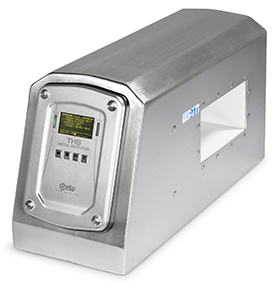
The THS/21ET metal detector series is a highly sensitive and precise measuring instrument. Data related to each detection and emission is stored in the event memory, allowing you to verify production quality, the inspection process itself, programming operations, and even regular functional testing steps with standard test samples.
FDA Code Title 21 Part 11 sets strict standards for programming access and computer data protection, and these standards are fully reflected in the firmware of the THS/21ET Series.
This fulfills the requirements for security, integrity, and traceability.
The THS/21ET Series employs a unique Auto-Learn system for food products, providing maximum sensitivity for all metals simultaneously with only one learning pass.
The system allows you to optimize detection sensitivity for any metal with the same level of speed and precision as hundreds of training passes performed with traditional methods, resulting in a high level of accuracy and efficiency.
Self-Calibration control ensures maximum repeatability and consistent performance over time and environmental changes.
By passing specific signals to the metal detector's transmit and receive chains, the detection characteristics are continuously monitored and any fluctuations that may occur due to environmental factors are continuously compensated for.
The result is system stability, consistency in detection performance, and neutralization of product effects.
The THS/21ET series introduces a new tool for installation and maintenance technicians to measure the environmental suitability of metal detectors.
Metrics include general mechanical and electromagnetic environmental conformance, specific electromagnetic conformance, and an automated check for the degree of metal interference from the conveyor belt.
This last feature is even more important given the high sensitivity levels of the THS/21ET metal detector series.
THS Production 4.0 software provides data collection and reporting capabilities for the THS 21 metal detection system.
The metal detector can be connected to an Ethernet network (optional IXC module required).
When used with THS Production Plus software, it enables remote management of production, full collection of technical and operational events, and generation of statistical and traceability reports that meet FDA 21 CFR Part 11 requirements.
Software diagnostics package with connection cable and hardware key:
With the THS/21 Series, connecting a maintenance technician's computer locally no longer requires physical access to the inside of the detector or the use of inconvenient connection cables.
The BT connection can be used for programming, signal monitoring with the CEIA MD-Scope program, and for transferring data stored in the metal detector event memory.
Industrial metal detectors for food applications typically have basic diagnostic capabilities based on transmitter/receiver signal monitoring.
However, this type of diagnostics cannot detect aging, thermal drift, and other subtle deviations. These factors can lead to reduced sensitivity, which can lead to undetected metal contamination.
The THS/21ET metal detector is equipped with advanced AUTOTEST features as standard, ensuring the following capabilities.
In addition to the AUTOTEST function, the THS/21ET and THS/ET-3F detectors can be programmed to automatically perform periodic verification of the calibration status. This feature is called AUTO-QC™ TEST.
With AUTO-QC TEST, you can reduce or eliminate manual calibration verification by operators.
The metal detector provides a programmable output that can be connected to a conveyor line stop to prevent product ejection and waste during AUTO-QC testing.
The CEIA AUTO-QC TEST provides an effective calibration check and can programmatically reduce manual verification from 0 to 1001 TP3T, with a corresponding reduction in.


Address:220, Bugwang-ro, Sosa-gu, Bucheon-si, Gyeonggi-do, Republic of Korea
Representative : Cho Hun
Business license number : 113-22-11111